Enterprise AI gateways are quickly becoming the default for deploying AI in large organizations. Instead of allowing every application to communicate directly with LLM providers like OpenAI or Anthropic, enterprises route AI traffic through a single gateway. It gives platform teams a single control plane, providing multi-model support and helping to make AI deployments secure, compliant, and manageable at scale.
Some vendors also promote another compelling benefit: Zero-Data Retention (ZDR) by default. The message is reassuring. Prompts and responses are forwarded to the model, processed, and discarded, allowing organizations to leverage AI without worrying that sensitive information is being stored or used for model training.
Unfortunately, that promise often does not align with reality.
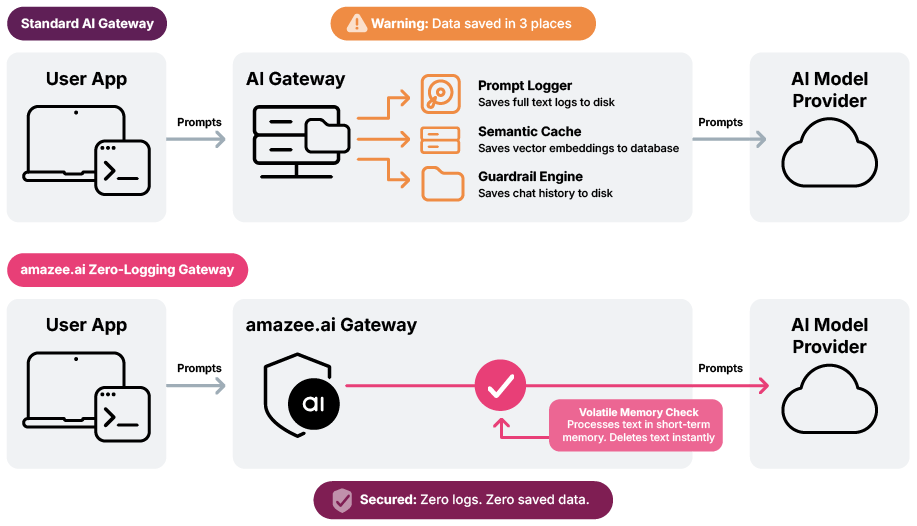
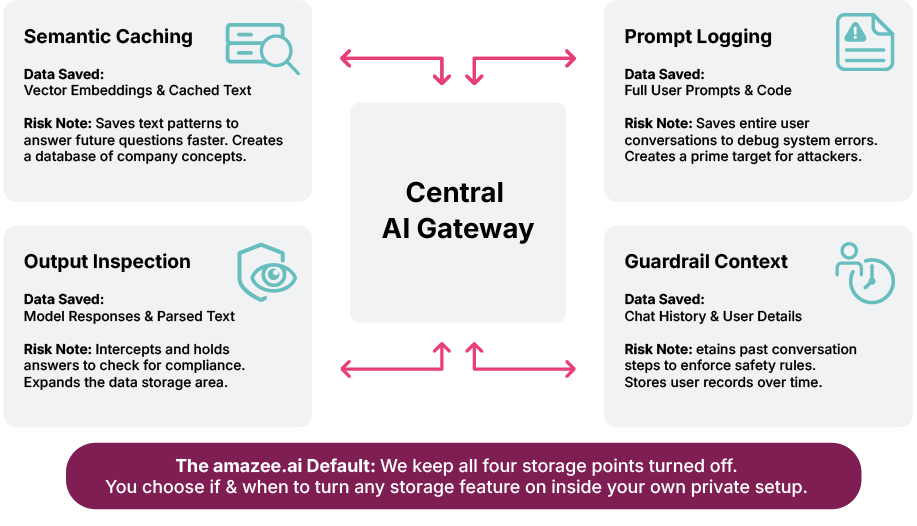
Some of the features that make an AI gateway particularly attractive to enterprises reside in the middleware between input and LLM processing on the GPU: semantic caching, prompt logging, output inspection, analytics, debugging, and guardrails. But they often depend on inspecting, retaining, or deriving information from customer interactions. The gateway is no longer just forwarding requests; it is actively processing and sometimes logging them.
That distinction matters. At amazee.ai, the gateway is designed around a different default: Zero-Data Retention. We do not log prompts, responses, or customer data by default, nor do we use other models for pre- or post-processing in the middleware.
If a feature requires logging or processing of input information to work, for example, PII Scrubbing, users will have to actively opt in to this feature.
The New Data Gravity
Security teams have long followed a simple principle: minimize where sensitive data lives. Every additional copy increases the risk, complicates compliance, and creates another system that must be secured, monitored, and audited.
Without a gateway, an application’s interaction with an LLM can be relatively straightforward. A prompt is sent, a response is returned, and, assuming the provider offers zero-retention guarantees, the interaction disappears.
Introducing an enterprise AI gateway, however, can make that lifecycle more complex. Every request may now pass through authentication services, policy engines, logging systems, analytics platforms, caching layers, and inspection pipelines before reaching the model. Each component may create another copy of the data, whether temporarily or permanently.
Ironically, organizations may spend months evaluating the privacy guarantees of their LLM provider while introducing a gateway that retains significantly more information than the provider ever intended to.
This is why the gateway’s default behavior matters. If the gateway becomes the central route for AI traffic, it should not also become an archive of your sensitive information.